
Identification of Material Issues
Process of Identification of Material Issues

Understand the organization's context
Based on the five principles of the AA1000 SES (2015 edition), TXC has identified the six stakeholder groups, including employees, customers, investors, suppliers, public interest group, and government agencies, based on the list of stakeholders from the industry; these stakeholder groups were then discussed and confirmed by the Sustainability Committee. Collect and compile sustainability issues with a total of 21 issues of concern.

Identify actual and potential impacts
In order to set an industry model and to take into account the rights and interests of various stakeholders, TXC responses, formulates and implements action plans through various communication channels in the table below. We continue to communicate the results of the communication to stakeholders, collect and identify actual and potential impacts of various issues of concern, and provide feedback so that we can achieve the goal of sustainable development.

Assessing impact significance
Based on the actual and potential impact content and feedback of each issue of concern raised by various stakeholders and assess the degree of impact. Prepare important information that are agreed upon and ranked by the Sustainability Development Committee then rank the major topics for this year, and submit it to the Board of Directors.

Prioritize the most significant impacts
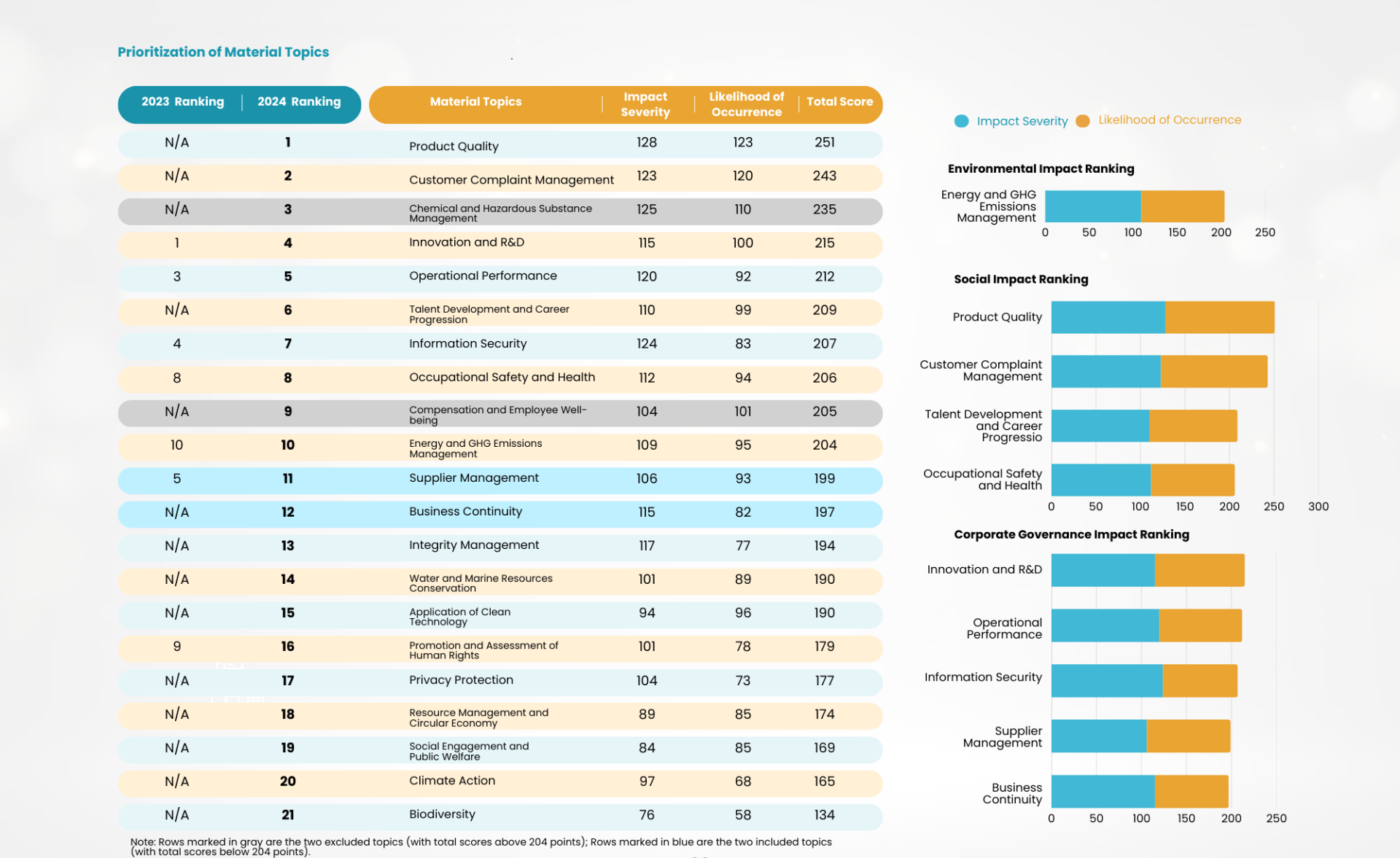
To prioritize the material topics for this report, we analyzed the degree of impact on each topic based on the "severity of impact on environmental protection, social responsibility, and corporate governance" and the "likelihood of occurrence", and then ranked the topics of this year's most significant impact to determine the material topics.
Analysis of material topics
Results of Analysis of Material Topics
For material topics this year, the Sustainable Development Committee ranked each topic by the total impact score (the total score of "Impact on Environmental Protection, Social Responsibility, and Corporate Governance" and "Likelihood of Occurrence"), and ranked them in descending order, as shown in the table below. In general, a total score of 204 was used as the threshold of materiality. After discussing other factors, such as operational impacts or customer requirements, two issues were excluded (with a total score of 204 or higher), and two issues were included (with a total score of less than 204), for a total of 10 material topics.
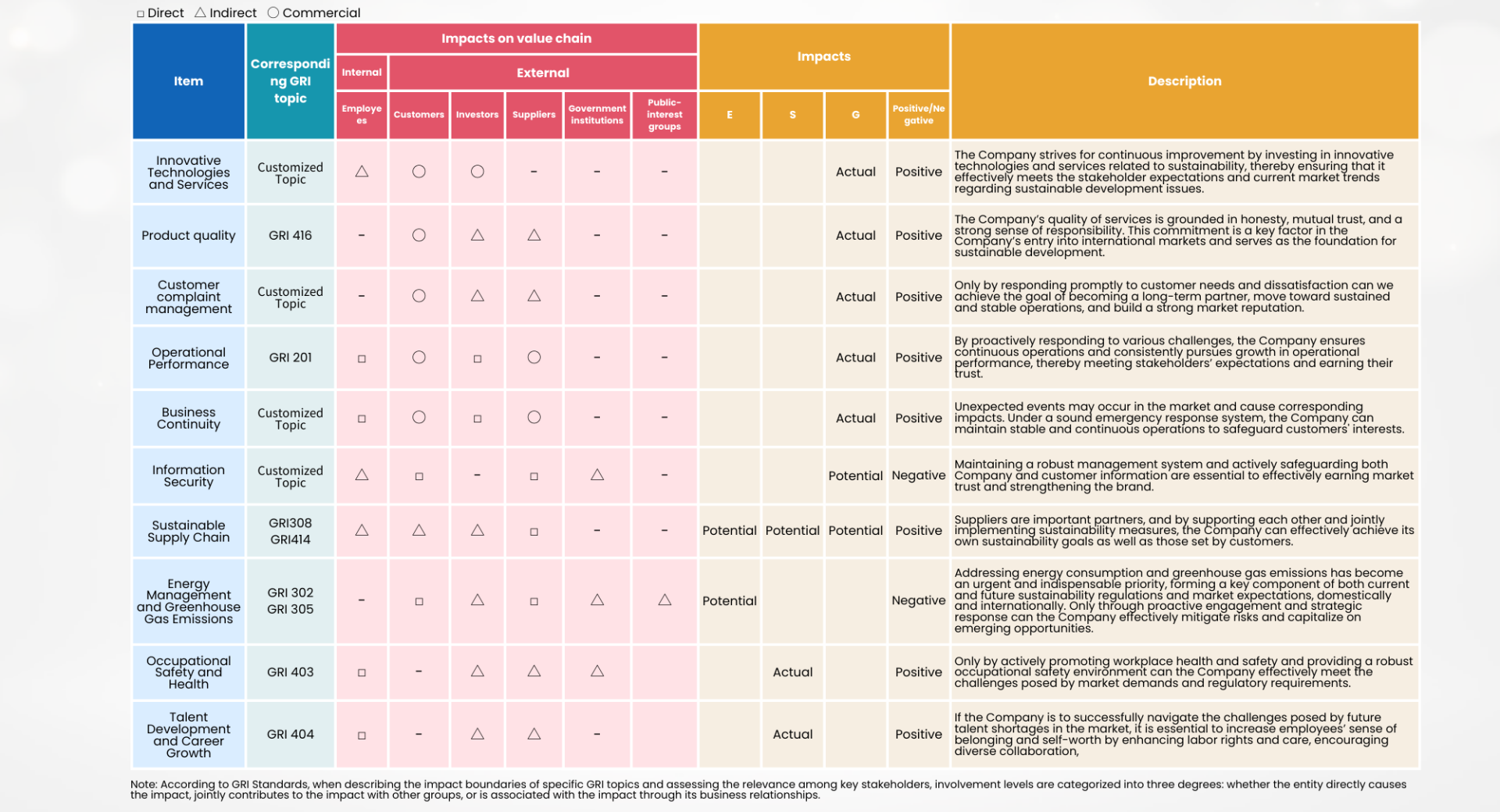
Material Topics and Boundaries
Material Topics and Boundaries
TXC has established management policies and planned action plans for major topics. The established goals and indicators were based on past data, strategies are formed and results are tracked regularly. For other non-major topics, relevant indicators and sustainable results would be disclosed to the stakeholders in accordance with current management processes and measures.